Pages

Showing posts with label Science. Show all posts

Tuesday, 7 December 2021

Making Hokey Pokey πŸ―πŸ˜‹

Aim:

I want to find out how to make Hokey Pokey.

Research:


Method:

Equipment:
  • Sugar
  • Baking soda
  • Golden Syrup
  • Tablespoon
  • Saucepan/pot
  • Something metal to mix with.
  • Cookie cutter (if making honeycomb/dalgona λ‹¬κ³ λ‚˜)
  • Non-stick baking paper
  • Bunsen Burner
  • Tripod
  • Gauze Mat
  • Heating tray
Instructions:
  1. Wash your hands
  2. Get all required equipment.
  3. Set up the Bunsen burner and the tripod.
  4. Put the pot on top of the tripod over the Bunsen burner.
  5.  Light the Bunsen burner and close the hole. (medium heat)
  6. Add 5 table spoon of sugar on the pot.
  7. Wait till the sugar melts a little, then add 2 tablespoon of golden syrup to the pot.
  8. Melt and mix.
  9. Turn off the gas and add one teaspoon of baking soda and mix.
  10. Scrape the hokey pokey on to the baking paper.
  11. Let it cool for about a min.
  12. Press a cookie cutter into the hokey pokey.

Results:


Discussion:

Tuesday, 30 November 2021

Making Ginger Beer 🍠🍺

Aim:

I want to find out how to brew/make ginger beer.

Research:

Link


Results:
Before -->

 After -->  

It tasted really disgusting. It tasted sour at first but then it tasted bitter. It smelt like barf and rotten drinks. It look like lemonade but don't let it's looks deceive you. The sweet taste disappeared compared to before i left it out.

Discussion:

What is fermentation? 
Fermentation is like brewing. It's a process in which the sugar breakdown into alcohol. The yeast eats the sugar and releases carbon dioxide and alcohol.

What is the difference between beer, cider, wine, vodka and whiskey?
They all have different sources of sugars that get fermented. For example, cider's source of sugar is apple, vodka's source of sugar is potato.

Thank you for reading this blog post.


Thursday, 18 November 2021

Red Cabbage Indicator

 Aim:

I want to find out how red cabbage can tell if a liquid is an acid or base.

Research:


Method:
Equipment:
  • Beaker
  • Red Cabbage
  • hydrochloric acid (the acid)
  • sodium hydroxide ( the base)
  • Something to mix with. (we used a dropper)
  • Boiling water.
  • Test tube. 
Instructions:
  1. Get all your equipment
  2. Wash your hands.
  3. Pour boiling water into a big beaker.
  4. Rip the red cabbage into little pieces.
  5. Add the bits of red cabbage into the beaker.
  6. Mix the red cabbage with the boiling water until it becomes a dark colour. (we used a dropper to mix it together)
  7. After mixing, with a dropper, add about 10 drops of the red cabbage juice into each of the big test tubes.
  8. Add 10 drops of the acid on one of the test tubes and add 10 of the base to the other test tube.
  9. The test tube that has only acid on it and the test tube that only has the base in it are the full colours if you only add acid or base.
  10. Experiment with the red cabbage, the acid and the base. Add as many drops to make different colours.
Results:

Discussion: 
What is an acid and a base? 
An acid is a substance that contains a lot of hydrogen ions. Hydrogen ions is when a hydrogen atom loses or gains an electron. A base is a substance that has a lot of hydroxide ions. Hydroxide ions is when oxygen and hydrogen atoms it is held together by one pair of electron. Acid can give protons to base. And base can accept protons given from the acid.

What do chemical indicators do?
Chemical indicators gives a visible sign to represent what substance it has. The visible sign is the liquid changing colours.


Thursday, 11 November 2021

Making Sherbet🍧🍨πŸ₯„

Hello everyone. One tuesday we tried to make sherbet. Here is what we did:

Aim: 

I want to find out how to make sherbet.

Research:

How to make sherbet:


Sherbet


Method:

Equipment:
  • Citric Acid
  • Raro
  • Baking Soda
  • Tartaric acid
  • Paper
Instructions:
  1. Wash your hands
  2. Get all required equipments
  3. Place the paper on your table.
  4. In piles, separate the 3 powders
  5. Using your popsicle stick, mix some of each powder.
  6. Taste the sherbet.
  7. IF there is to much baking soda, add more citric acid.
  8. If there is too much citric acid, add more baking soda.
  9. If the flavour tastes bitter and sour add more Raro to balance the taste.
Results:


It tasted sour at first but i liked it sour. I had more fizz in my sherbet than taste. I liked adding more raro than fizz so it tasted more like Raro than sherbet.

Discussion:
Why did the sherbet not foam on the paper but it did in your mouth? 
Citric acid and baking soda some atoms contained into these powders turn into carbon dioxide. As the gas escapes the sherbet starts to bubble up in water or your mouth.

What was the chemical reaction in the sherbet?
The foam was caused by the liquids in your mouth which reacted to the carbon dioxide mixed into sherbet.

What type of chemical reaction is this?

Neutralization.


Tuesday, 2 November 2021

Blind Taste Testing Challenge πŸ™ˆ πŸŠπŸ‡

Aim: 

I want to find out if food taste differently when you can't see or smell the food your eating.


Research:


Method:

Equipment:

  • Blindfold
  • Mystery Food
  • Popsicle stick

Instruction:

  1. Get all Equipment.
  2. Wash hands.
  3. Put on your blindfold.
  4. With one hand pinch your nose.
  5. With the other hand have your hand out and wait for the unknown food.
  6. Get your food and eat it.
  7. Unblock your nose and see if the tastes are different.
Results:
Unknown FoodBlindfold tastewithout nose blockedFood Guess
1sweetsweetsugar
2saltyI tasted it at the back of my tongue the mostsalt
3bitterit taste bad bad bad bad bad badsomething bitter
4lemonsour, and sweetcitric acid
5salty, bitterpicklepickle
6crunchy, bitterstarchraw potato
7crunchy sweetsweetapple
8sweet, crumblyrottenpear
9feels like chalksweet, powderymarsh mallow
10taste like crisptaste like pickleburger ring
11sour sweet yummyorange
orange gummy lollie


Discussion:
How do you taste food? Your taste buds on your tongue are very small. some of your taste buds can only detect one kind of taste some taste buds can taste all kind of different taste.

What are the different taste? 
Sweet, sour, bitter, salty or uman which is like a meaty taste that you enjoy to eat. Like what you taste when you eat your favourite meal kind, of like tasting a juicy rich, flavour.

Tuesday, 26 October 2021

Eating Hot chilli 🌢🌢πŸ”₯πŸ”₯πŸ”₯πŸ”₯

Aim: I want to find out how to get rid of burning chilli off my tongue.

Research: 


Method:

Equipment

  • Fizzy
  • Milk
  • Water
  • Popsicle stick
  • Chili sauce (carolina reaper)
  • cup
  • Timer

Instructions

  1. Get all required equipments.
  2. Scoop some chilli onto your stick.
  3. Start the timer and eat the chilli
  4. Stop the timer after 4 mins.
  5. Rate how hot your mouth has become.
  6. Do the experiment again but drink water after 2 minutes.
  7. Do experiment again but drink coca-cola poured into a cup after 2 minutes.
  8. Do experiment again but drink milk after 2 minutes.

Results:
The first time I had chilli, It was burning my mouth. I had it without any liquid score 10.
The second time I tried the chilli I did it with water, I rate it a 10 
The third time I did tried the chilli I did it with coca cola, it made it made worse, I rate it 11
The fourth time I tried the chilli I did it with milk, I rate it a 4


Discussion:
Why does chilli burn your mouth?
A chilli has this oil-based molecule called capsaicin. It gets released to your saliva and bins onto the receptors in your mouth and tongue. Which then triggers the receptors to send signals to your brain, thinking you are currently burning.

Why did the milk reduce the burn?
Milk mostly contains casein, which i learnt in the plastic milk experiment. The casein helps wash off the capsaicin in your tongue or mouth. Think of it like soap washing off grease.


Tuesday, 19 October 2021

Bacteria Around Our School 🦠

 Aim:

I want to find out what type of bacteria are around our school.

Research:


Method:

Equipment: 

  • Cotton Buds
  • Agar Plates
  • Marker Pen
  • Sellotape
Instructions
  1. Wash your hands.
  2. Get all equipment
  3. Use a marker pen to write your name and where you got the bacteria on the lid.
  4. Wet the cotton bud with water and swab the surface.
  5. Gently swab the agar plate.
  6. Tape around the edges of the agar plate.
  7. Put the agar plate in an incubator overnight.
  8. Observe what happens on the plate the next day.

Results: 


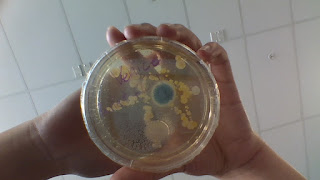
The types of bacterias in my agar plate contained different types of bacteria.
The white blobs could be are poop bacteria or known as E. coli.
The yellow, gold or orange blobs could be streptococci or throat infection.
The pink blobs (found on my classmates experiments) could be salmonella, something that makes you have food poisoning.
The red blobs (which no one had) could be meningitis something that can make you have a brain infection.

Thank you for reading this blog post.
Have you grown bacteria before?

Wednesday, 7 July 2021

Measuring Mentos ad Coke πŸŒ‹ πŸ₯€

HEllo everyone.

This week in Science, Chemistry we are trying to experiment with coke and mentos. Here is what we are working on.

Aim: I want to find out how many bubble are made when mentos is dropped in coke.

Method:
    Equipment: 
  • Coke, Coke Zero, Sprite
  • Mentos
  • Measuring cylinder, 100 ml & 10 ml
  • Small beaker
  • Safety Glasses
  • Liquid Soap/Detergent
Instructions:
  1. Get all required equipments.
  2. Wear safety glasses
  3. Pour 20 ml of coke into the 100ml measuring cylinder.
  4. Add 5 ml of the detergent in to the 100 ml measuring cylinder with the coke.
  5. Add the mentos.
  6. Wait for the fizz to happen.
  7. Measure the height of where the bubbles end up.
Results:
CokeCoke ZeroSprite
Height of bubbles45 mL35 mL40 mL

Conclusion

I found out that if you add detergent to the mentos and coke experiment the bubbles stay on its same place.
I also found out that the sprite is more effective than coke and coke zero even though coke was the highest because we didn't add the equal amount of each fizzy.

Tuesday, 6 July 2021

Milk Plastic (casein)πŸ₯›πŸ€―

 Hello everyone.

This week in Science, Chemistry we are trying to make milk plastic. Which is also known as Casein. Here is what we've been doing so far.

Aim:

I want to find out how to turn milk into plastic


Method:

    Equipment:
  • Stove/Oven/Microwave
  • Measuring Cup
  • Measuring spoons
  • Milk (1 cup)
  • Pot/Bowl (microwavable container)
  • White vinegar
  • Paper 
  • Spoon
  • Mug
  • Food colouring , glitter, cookie cutter (optional)
    Instructions:

  1. Get all equipment
  2. Pour 1 cup of milk into your pot/ microwavable container.
  3. Heat the milk in the microwave or on on the stove until it is steaming.
  4. Add 4 teaspoon of white vinegar to a mug.
  5. Add the hot milk to the mug with the vinegar.
  6. Stir the mixture of the milk and vinegar with the spoon.
  7. Stack 4 layers of paper towels on a surface that is safe to get damped.
  8. Scoop out the curds with the spoon and place them on the paper towels
  9. Fold the papers towel over the curds and press down to absorb the extra liquid .
  10. Knead all the curds together and shape it to a ball of dough.
  11. Color, shape or mold the dough. Colour your doah with food colouring.(Optional)
  12. Put all the milk plastic creations you have made on a paper towel and let them dry overnight.
  13. Now you have made Milk Plastic.
What is casein? 
Casein which is a latin word which means 'cheese' is a protein also found in other dairy products. This is why casein might be considered as a dairy product. When milk is heated and combined with acid such as vinegar the casein molecules reorganize into a long chain. The substance it ends up into is the same as  plastic and which involves with this experiment. 

Results:


Tuesday, 29 June 2021

Gummy Bear Osmosis 🧸🧫

 Hello everyone today in chemistry, science, we are starting to experiment with gummy bears. Here is what we are currently doing.

Aim: I want to find out what happens to gummy bears when left in liquids.

Method:

Equipment:
  • Water
  • Liquids - water, salt water/(sodium chloride), sugar water/(glucose).
  • Electronic scale
  • 4 petri dishes
  • Marker pen
Instructions:
  1. Get all equipment required
  2. On the petri dish write down you name, the condition (water, sodium chloride, glucose).
  3. Weigh a gummy bear and write down the weight of the gummy bear on the petri dish.


Wednesday, 23 June 2021

Edible SlimeπŸ€“

 Hello everyone.

Today in science, chemistry we are trying to make an edible slime. It's a treat because our class's science teacher has not been in class recently last week.  Here is what we are doing.

Aim:

I want to find out how to make edible slime.

Method: 
    

    Equipment
  • Marshmallows
  • Spatula (Something to mix with)
  • Bowl/cup
  • Icing Sugar
  • Microwave
  • Vegetable Oil (optional)
Instructions
  1. Get all equipment
  2. Put marshmallows in cup/bowl and put in microwave for 10 seconds or more if not melted enough.
  3. Mix well with a spatula
  4. Add icing sugar
  5. The texture is good enough if it becomes difficult to mix with a spatula anymore.
  6. Wash hand and let the slime cool if you decide to play with the slime.
  7. Mix with hands after using the spatula, if too sticky add more icing sugar.
  8. IF you want add vegetable oil if the texture is too hard.
  9. Enjoy
What it felt?
The slime was very sticky at first but after adding a lot of icing sugar it was functional enough to play with. Though it was hard to stretch.
What it smelt?
It smelt more like vegetable oil because of how much I added into the slime. 
It didn't stretch that much after i added a lot of icing sugar because of how sticky it was.


Thank you for reading this blog post.


Tuesday, 22 June 2021

Skittle Colours 🍬🌈

Hello everyone this week in science, chemistry we have been experimenting with sweets. Here is what experiment we are trying to do.

 Aim:

I want to find out what happens when put skittle in water.

Method:
    
    Equipment
  • Petri Dish
  • Skittles
  • Warm water
  • Beaker
Instructions
  1. Get all required equipment
  2. spread out your skittles around the edge
  3. Gently, pour the warm water into the center of the petri dish.
  4. Observe the next results of what happens.
Results:


Discussion:
Why did the colours leave the skittles?
The hard sugar coat around the skittles dissolves faster when on warm water. 
The colouring in the sugar drags around the hot water and makes the colorful mixture.

Why did the colours not mix?
Each skittle has different kind of flavours which is  density meaning that one colour can't mix because of their differences of how much density it has so some colours are in different levels of the water. 

Thank you for reading this blog post.
Always welcome to comment.
Have you ever done an experiment like this?


Wednesday, 26 May 2021

How to Light a Bunsen Burner ⚗️

 Hello everyone today in science we are trying to learn how to light a bunsen burner.

Aim:

I want to find out how to SAFELY light a bunsen burner.

Method: 

Equipment:
  • Lighter / Matches
  • Heat mat
  • Bunsen Burner
  • Safety glasses
Instruction:
  1. Get the all the equipments.
  2. Put on your safety glasses. (If hair is long, tie hair up)
  3. Place the heating mat underneath the bunsen burner.
  4. Connect the hose to the gas tap.
  5. Turn the collar to close the air hole.
  6. Light your match/lighter over the bunsen burner and then turn the gas on. (Make sure you arm is not over the bunsen burner)
  7. If finished using the bunsen burner turn it off by turning the gas off.

Results: 


Thank you for reading this blog post.
Always welcome to comment.


Wednesday, 19 May 2021

πŸ”₯Hand on Fire!πŸ”₯

Hello everyone today in science, chemistry we are learning to set our hand on fire safely. Here are what we are what we are talking about:

 Aim:
I want to find out how to set my hand on fire - SAFELY.

Method:

Equipment:
  • Large container of water
  • Detergent (Liquid Soap)
  • Hose
  • Gas
  • Lighter
  • Glasses
Instructions:
  1. Collect all needed equipment
  2. Fill in the container with water until 2 cm deep.
  3. Pour some detergent in the water and gently mix.
  4. Connect the hose to the gas tap.
  5. Turn on the gas tap and bubble it to the water. 
  6. If hair is long tie your hair up
  7. Wear safety glasses
  8. roll up sleeves pass your elbow or take your jacket off.
  9. Wet hands and arms with water.
  10. With both hands, scoop the bubbles on the water, but not the water.
  11. Take two steps forward away from the container of water.
  12. Light the bubbles
  13. To get rid of the fire hands must imitate of a high five.
Before

Results:


My experience:
I saw a big fireball like the explosions in movies but it was smaller.
I felt nervous at first but I ended it really quickly so I ended up being calm after the fire.
I didn't smell anything when it was my turn but with other I smelt a burning wood kind of smell.
I heard the 'wows' of the class and the comments. I also heard the lighter turning on and starting the fire.

Thank you for reading this blog post.
Always welcome to comment.

Wednesday, 5 May 2021

Safety in the Lab

Rules

  1. You must follow the instructions given by the teacher
  2. You must NOT enter the lab without supervision/permission.
  3. Report any breakages.
  4. Shoes must be worn at all times.
  5. Do not eat or drink in the lab.
  6. If you spill something, tell the teacher then clean it up.
  7. Wash your hands after doing experiments
  8. A heatproof mat should always be used when heating.
  9. If in doubt,ask the teacher.
  10. NEVER taste or smell chemicals.
1. Liquids do not go into the bins, because they go in the sink
2. Solids do not go down the sink because it can block the sink.
3. Wear safety glasses when you do experiments,
because experiments can explode and damage the eyes.
4. Put your chair under the desk, and stand at the bench
when you do experiments, because it harms people around you due to them might falling over.
5. Bags do not go on the desks, because there isn't any space to do experiments and chemicals might spill.
6. Long hair should be tied back, because it can catch on fire.
7. Do not smell the chemicals, because you can pass out/faint over tables or the floor.
8. Walk, don’t run around the room, because you can trip over and harm yourself
9. Do not eat or drink in the lab, because you may have chemicals on your hands and may cause vomiting.